
"Every man is a builder of a temple called his body.” ~ Henry David Thoreau
Human beings are complex, adaptive biological systems in continuous exchange with their environment.
At every moment, the nervous system interprets visual information—pattern, color, light, and spatial structure—processing these signals rapidly and often beyond conscious awareness. This constant stream of input shapes attention, emotional tone, and physiological regulation.
Fields such as Neuroscience and Neuroaesthetics reveal that the environments we inhabit are not passive backdrops, but active participants in this regulatory process.
Matchless Atlas™ explores how visual coherence and structured design can align with these biological systems — with the development of NeuroResonant Art™ as a means of supporting clarity, balance, and perceptual harmony.
THE SCIENCE
NEUROSCIENCEO
NEURORESONANCE
NEUROAESTHETICS
The human body is an intelligent, self-regulating network of systems working to maintain balance. Breathing, heart rate, neural signaling, and sensory perception operate continuously, coordinating responses to both internal and external conditions. This dynamic regulation is often described as homeostasis — the body’s ability to adapt and stabilize in changing environments.
The body functions through an interconnected system in which the brain, nervous system, cardiovascular system, and respiratory system constantly communicate through electrical signals, chemical messengers, and rhythmic patterns. These systems influence one another continuously: changes in breathing can alter heart rate, emotional states can affect muscle tension, and sensory input can shift cognitive processing.
Because of this interconnectedness, even small environmental changes can influence the broader system. The spaces we inhabit are not separate from biology — they participate in it.
Neuroscience → how the body/brain system works
NeuroResonance describes the relationship between visual structure and the body’s regulatory systems of perception and response.
When visual input aligns with the brain’s natural processing tendencies — through rhythm, proportion, symmetry, and natural patterning — it can support states of coherence, where attention, emotion, and physiological responses become more integrated and stable.
In this state, cognitive effort decreases and perceptual clarity increases. Environments that support this alignment help reduce internal friction between sensory input and neural processing demands.
NeuroResonant Art™, developed by Matchless Atlas™, applies these principles through visual compositions designed to interact with perceptual systems in a structured and intentional way. It translates scientific understanding of perception into environmental design that supports coherence, focus, and emotional equilibrium.
Neuroresonance = how to apply principles that affect change
The environment is continuously interpreted through sensory input—light, color, pattern, spatial structure, and contrast. These signals are processed by the brain and influence attention, emotional tone, and cognitive load.
Research in Neuroaesthetics and environmental psychology shows that visual structure plays a direct role in perceptual efficiency. Certain patterns — particularly those found in natural systems — are processed more fluently by the visual system, often associated with reduced cognitive strain and increased perceptual comfort.
Visual coherence, balance, and structured complexity allow the brain to organize information more efficiently. In contrast, visual overload, fragmentation, or excessive randomness can increase cognitive effort and reduce attentional stability.
Neuroaesthetics → how visuals affect perception
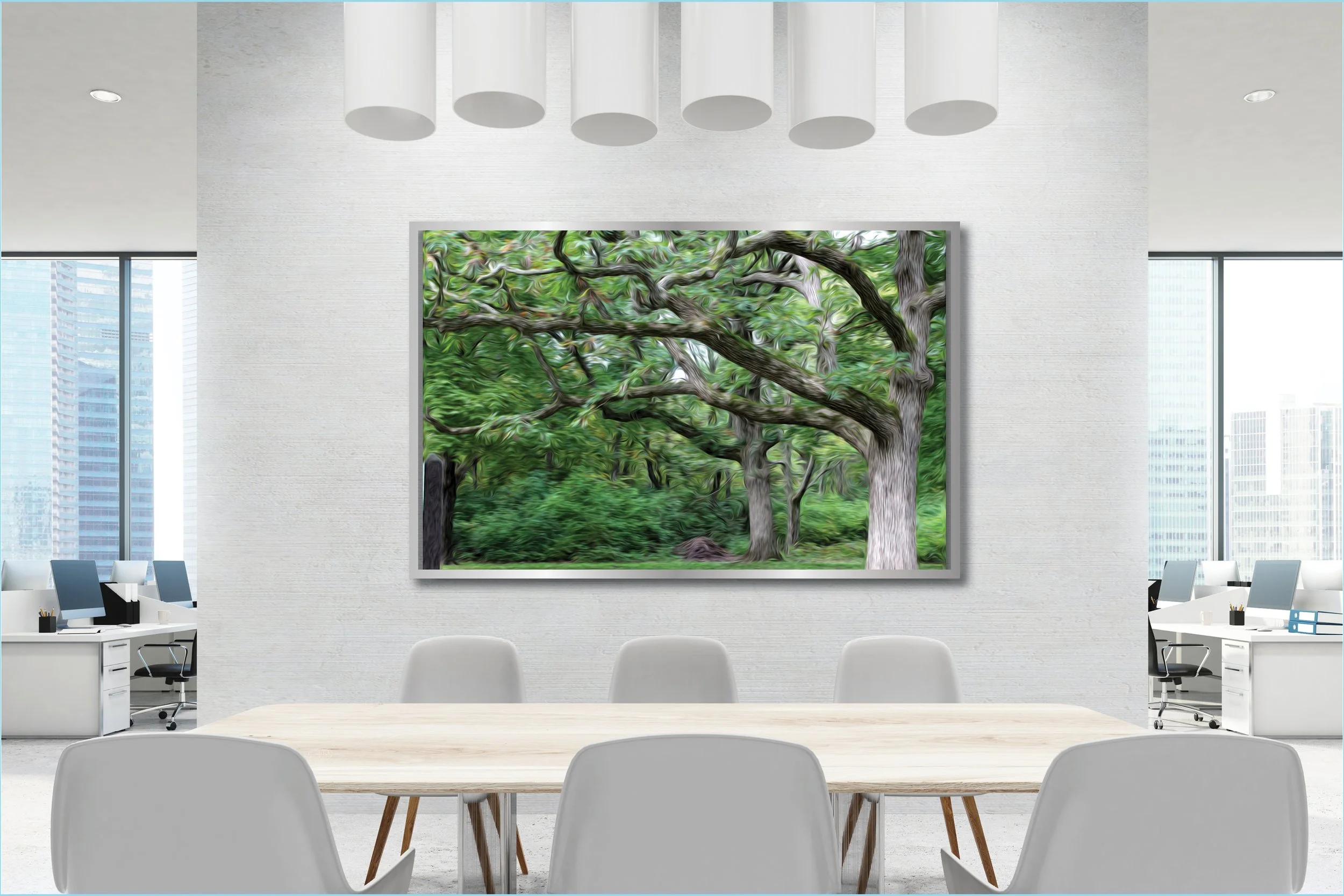
Featuring:
ENTWINED
Entwined embodies the geometry of the Tree of Life, where each element is intricately linked to the larger whole, harmonizing expansion with stability. The artwork resonates with the dynamics of the human body — specifically, the heart-brain network and the nervous system — where signals, energy, and circulation flow in unity. Artistically, Entwined radiates a spectrum from earthy tones to vibrant greens, wavelengths that the visual system associates with grounding and balance. Entwined serves as a reminder that every thought, action, and intention contributes to the collective whole, reinforcing the unity that binds us all.